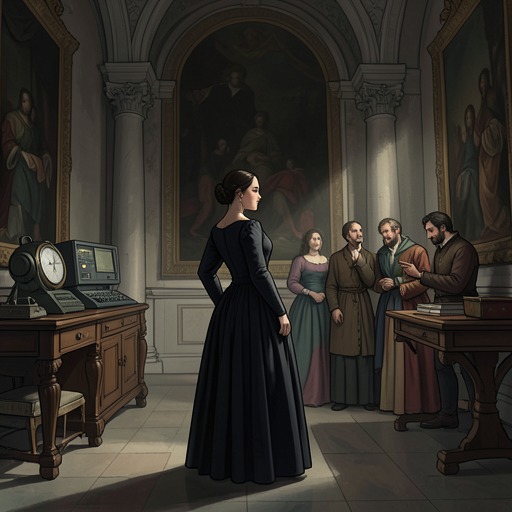
Princess Sherbatoff
In Search of Lost TimePrincess Sherbatoff is a wealthy Russian aristocrat whose high birth does not protect her from social ostracism. Estranged from her family and exiled from her native country, she has few friends; that isolation makes her exceptionally constant in her attachment to Madame Verdurin’s circle. By remaining with the group through the interruptions and competing obligations that make other members temporarily absent, she becomes the ideal of its “faithful.” Her character therefore joins two conditions that the salon likes to keep distinct: exclusion from the wider social world and complete belonging within its own.
Identity and Social Position
For years the Grand Duchess Eudoxie has received Princess Sherbatoff only in the early morning, when other visitors will not encounter her. The arrangement lets the Grand Duchess maintain a connection while keeping the Princess separate from the social company she otherwise receives. The Princess also visits the Baroness Putbus, but these friendships do not amount to broad acceptance: her social isolation has been in place for years, and the small number of people she sees reflects the limits of her position as much as any personal preference.
The narrator first encounters her without knowing who she is. On a local train, he takes her for a possible keeper of a brothel; when Cottard and the other regulars find her in an empty compartment reading the Revue des Deux Mondes, her name makes her social identity legible. The sudden correction exposes the limits of appearance-based judgment: the woman whose status seemed uncertain is of exalted birth and, within the Verdurins’ salon, a valued figure. The narrator treats the revelation of her name as the solution to a social puzzle, and the railway, like a restaurant or casino, becomes a place where such enigmas may be encountered before they can be understood.
Loyalty to the Verdurin Circle
After visiting the Grand Duchess, the Princess has for years gone to Madame Verdurin, often beginning the day there and remaining with her. She accompanies the Verdurins on holiday, moves from one boarding-house to another as they move, and does not treat travel, illness, or family obligations as reasons to leave the circle. On New Year’s Eve, when Madame Verdurin worries about being left alone, the Princess answers that the following day is one for staying with family and that Madame Verdurin is her family. Her fidelity is not simply attendance at a recurring gathering: it shapes her daily visits, holidays, living arrangements, and understanding of kinship.
That constancy distinguishes her from the other members Madame Verdurin calls the faithful. Even the most devoted guests have sometimes travelled, fallen ill, entered military service, or gone to a dying parent. Madame Verdurin has tried to make her circle the members’ foremost allegiance, but those claims cannot prevent ordinary ties and circumstances from drawing them away. The Princess’s isolation, by contrast, allows a loyalty that the others cannot match. Madame Verdurin recognizes this exceptional attachment and asks the Princess to promise that whichever of them outlives the other will be buried beside her. Their bond is thus imagined as lasting beyond the social life of the salon itself.
The Princess presents this narrow circle of friendships as a deliberate choice rather than as the result of exclusion. To strangers, she says that she sees nobody else and visits only three houses: those of the Grand Duchess, the Verdurins, and the Baroness Putbus. The account she gives makes restriction sound like a rule she has freely adopted. The narrator notes that Madame and Monsieur Verdurin help circulate this version among the faithful, who in turn accept a mutually flattering picture: the Princess has supposedly chosen their salon over the many invitations available to her, while the Verdurins have supposedly made a single exception for a great lady more intelligent than other aristocrats. Her social vulnerability is thereby converted into evidence of selectiveness, and the circle’s exclusiveness is presented as mutual distinction.
Presence at Gatherings and Social Performance
At the theatre, the Princess uses her wealth to engage a large ground-floor box for first nights and invites the faithful, and no one else, with Madame Verdurin’s consent. Yet she chooses the least prominent box and sits at the back, attending to her circle rather than the rest of the house. Shortly before the performance ends, the group withdraws after her. Those who observe her see both her influence and her humility: she is a focal point of the group without making a public display of rank. The narrator describes her as shy and bewitching, with a beauty that has faded rather than disappeared.
Her reserve also shapes how she behaves when the circle reaches her on the train. She has learned, out of fear of rebuffs, to keep her place in life as she does in a carriage, and not to offer her hand until someone has greeted her. When the Verdurin regulars enter her compartment, she continues reading; only after Cottard addresses her does she raise her eyes and welcome them. Her manners do not suggest indifference so much as a protective habit formed under conditions in which an offered greeting might go unanswered. The narrator notices that her eyes register the group even while she appears not to have noticed its arrival.
The Princess is also a physical point of refuge within the salon’s performances. When Brichot’s remarks about Maecenas turn into an extended tirade about contemporary spiritual and artistic life, Madame Verdurin takes hold of the Princess’s shoulder and hides her face there. The gesture is presented as a comic means of concealing her laughter, as well as part of Madame Verdurin’s familiar way of responding to music and conversation. The Princess’s place in the group is therefore expressed not only through long-term loyalty but through these moments of easy bodily familiarity, which make her a trusted companion in the salon’s private theatrics.
The Circle’s Public and Private Meaning
The Princess’s fidelity carries unusual weight because it answers the Verdurins’ fear that the faithful will eventually defect. Madame Verdurin has invoked her authority over the circle with the force of a commander or religious leader, urging its members to choose her over family and other attractions; nevertheless, even the most regular guests are sometimes absent. Against that pattern, the Princess seems to embody the permanence Madame Verdurin had thought unattainable. Her very lack of social alternatives makes her an ideal member, while her aristocratic birth and wealth give the group a prestigious figure around whom it can organize its self-image.
The narrative repeatedly places that image beside its less flattering conditions. The Princess’s claim that her narrow circle is a matter of taste stands alongside the account of her estrangement, exile, and restricted access to other households. The Verdurins’ story of mutual preference does not erase those facts; it shows how exclusion can be narrated as choice and how a salon can turn loyalty into social distinction. In this way, Princess Sherbatoff is more than an unusually faithful guest: her place in the group reveals the emotional dependence and status-making that sustain its sense of belonging.
Her life in the circle is organized around recurring acts of attendance: the early visit after the Grand Duchess, the day spent with Madame Verdurin, the shared holidays, the theatre box, and the prospect of burial side by side. Yet the Princess does not simply disappear into the group’s rituals. Her careful reserve, aristocratic identity, and choice to maintain a small set of friendships give her a distinct presence within them. That combination explains why Madame Verdurin treats her as the exemplary faithful and why the narrator sees in her both a socially enigmatic woman and the pearl of the salon.